Paris is a city defined by its artistic giants, from the sprawling corridors of the Louvre to the industrial grandeur of the Musée d'Orsay. Yet, nestled quietly in the western corner of the Tuileries Gardens, overlooking the Place de la Concorde, lies a sanctuary that offers a more intimate, spiritual encounter with art. The Musée de l'Orangerie is often described as a jewelry box of Impressionist and Post-Impressionist wonders. Unlike its larger neighbors, this museum invites you to slow down, breathe, and let the art wash over you. As we navigate through 2026, the allure of this specific cultural landmark remains as potent as ever, offering a peaceful retreat where architecture and painting merge into a singular aesthetic experience.
Walking toward the entrance, the building itself tells a story of transformation. Originally built in 1852 under the orders of Napoleon III, the structure was never intended to house priceless canvases. Its initial purpose was purely functional: to shelter the orange trees of the Tuileries Palace during the harsh winter months. The high glass windows on the southern façade were designed to capture sunlight, a feature that would later prove providential for the display of art. Today, the museum stands as a testament to adaptive reuse, preserving its neoclassical elegance while serving as a modern vessel for some of the most significant works of the early 20th century. Exploring the Orangerie is not just about seeing paintings; it is about experiencing a space where natural light plays a crucial role in how we perceive color and form.
Monet’s Water Lilies: A Cinematic Masterpiece
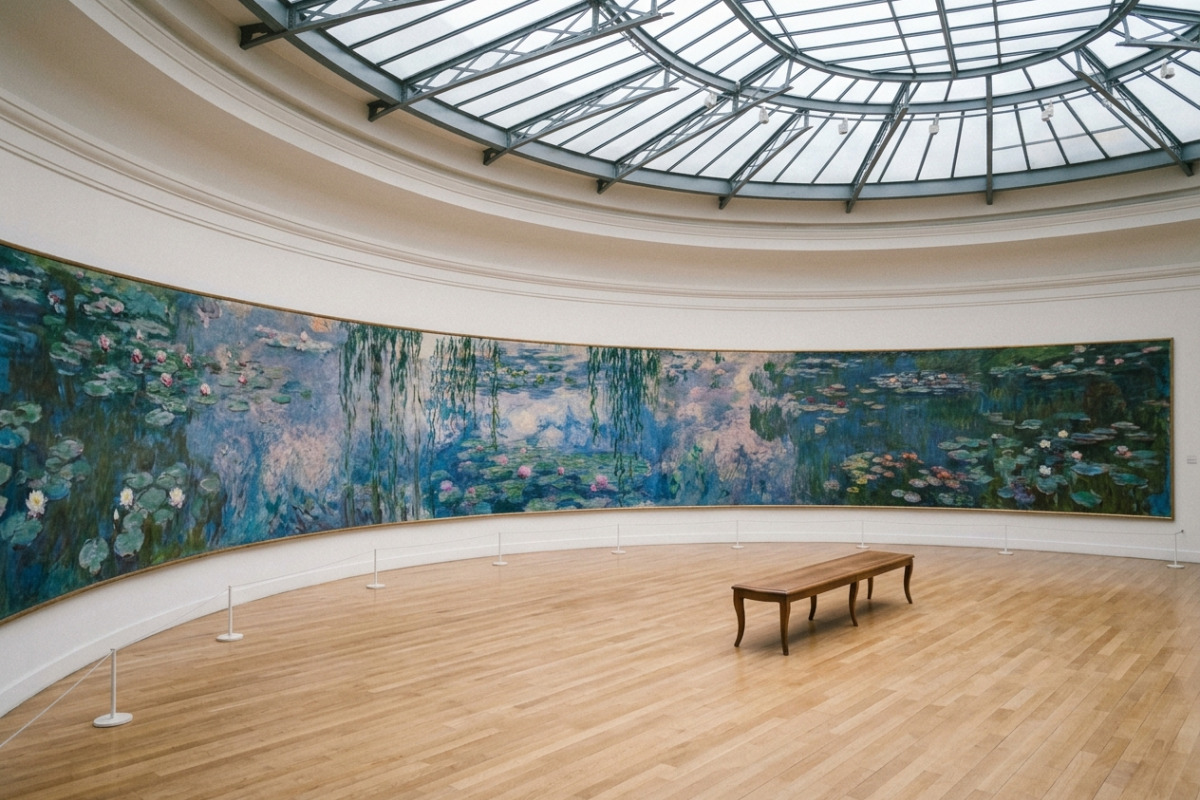
The undisputed heart of the Musée de l'Orangerie is the oval rooms housing Claude Monet’s Nymphéas (Water Lilies). This installation is widely considered the crowning achievement of Monet’s career and the ultimate expression of Impressionism. Monet donated these panels to the French state following the armistice of World War I as a symbol of peace. He collaborated closely with the architect Camille Lefèvre to design the space, ensuring that the rooms would curve to match the horizon of the paintings. The result is an immersive environment that wraps the viewer in a continuous embrace of nature, water, and light.
Entering these rooms feels like stepping into a waking dream. The eight massive panels, measuring nearly two meters in height and spanning a total length of 91 meters, depict the water garden at Monet’s home in Giverny. There is no horizon line and no shore; the viewer is suspended in the center of the pond, surrounded by floating lilies, reflecting clouds, and the weeping willows that frame the composition. The natural light filtering through the ceiling creates a living experience; the paintings seem to shift in tone depending on the time of day and the weather outside. Whether it is a bright morning or a moody, overcast afternoon in Paris, the Nymphéas offer a moment of profound contemplation.
The Technical Brilliance of the Oval Rooms
The architectural layout of the Water Lilies gallery is unique in the world of art museums. The two oval rooms form the sign of infinity, perhaps a subtle nod to the endless cycle of nature and the timelessness of art. The vestibule leading into the rooms serves as a decompression chamber, allowing visitors to leave the noise of the city behind before entering the sanctuary. Inside, the absence of corners removes distinct boundaries, enhancing the feeling of infinite space. Monet wanted the viewer to be completely absorbed by the work, creating an "illusion of an endless whole, of water without horizon or bank." This specific design requirement makes the Orangerie the only place in the world where these panels can be seen exactly as the artist intended.
The Walter-Guillaume Collection: The Lower Level Treasures
While many visitors come solely for Monet, the lower level of the museum houses a collection that is equally staggering in its quality. Known as the Jean Walter and Paul Guillaume Collection, this assortment of works provides a comprehensive overview of modern art from the late 19th to the early 20th century. Paul Guillaume was a visionary art dealer and collector who championed young artists who would later become legends. His taste was impeccable, bridging the gap between Impressionism and the radical modern movements that followed. After his death, his widow Domenica, who later married Jean Walter, continued to shape the collection, eventually donating it to the state.
This section of the museum offers a fascinating dialogue between different artistic movements. You are not just looking at isolated paintings; you are witnessing the evolution of modern art. The collection is dense with masterpieces, featuring works by Renoir, Cézanne, Picasso, Matisse, Modigliani, and Soutine. The layout is intimate, allowing you to get close to the brushstrokes and appreciate the texture of the paint. It serves as a perfect counterpoint to the ethereal nature of the Water Lilies upstairs, grounding the visitor in the vibrant, sometimes chaotic energy of the Parisian art scene of the 1920s and 30s.
Key Artists and Their Contributions
| Artist | Style/Movement | Highlights in the Collection |
| Pierre-Auguste Renoir | Impressionism / Classicism | Focuses on his later period, featuring voluptuous figures and soft, warm palettes. Notable works include Young Girls at the Piano and Gabrielle and Jean. |
| Paul Cézanne | Post-Impressionism | The bridge to Cubism. The collection features his iconic landscapes and still lifes, including The Rock Rouge and various portraits of Madame Cézanne. |
| Amedeo Modigliani | Modernism / School of Paris | Known for elongated faces and almond eyes. The museum holds several poignant portraits, such as The Young Apprentice, showcasing his unique melancholic style. |
| Henri Matisse | Fauvism / Modernism | Works that emphasize color and decorative patterns. The collection includes the famous Odalisque with Red Trousers. |
| Pablo Picasso | Cubism / Classicism | The collection focuses heavily on his "Return to Order" period and large-scale nude figures, offering a different perspective from his fragmented Cubist works. |
Beyond these giants, the Walter-Guillaume collection also features works by lesser-known but equally significant artists. André Derain, a key figure in the Fauvist movement alongside Matisse, is represented by several landscapes showcasing his bold use of color. Chaim Soutine, known for his expressive and often tormented portraits, offers a glimpse into the darker side of the Parisian art scene. His paintings, characterized by thick impasto and distorted forms, provide a powerful contrast to the more serene works of the Impressionists. Exploring these lesser-known artists adds depth and nuance to the overall experience of the collection.
The Unique Architectural Charm
The Musée de l'Orangerie is not merely a container for art; it is an architectural gem in its own right. The renovation projects over the decades, particularly the major overhaul completed in the early 2000s, successfully reconnected the building with its original identity. The removal of the second floor, which had been added in the 1960s, allowed natural light to once again flood the Monet rooms, restoring the artist's original vision. The building's dialogue with its surroundings is palpable. Through the windows, you can see the Seine, the Tuileries Gardens, and the distant silhouette of the Eiffel Tower, anchoring the art firmly in the heart of Paris.
The interior design strikes a balance between historical preservation and modern minimalism. The concrete structures and clean lines of the lower levels provide a neutral backdrop that lets the vibrant colors of the Walter-Guillaume collection pop. The grand staircase and the flow of the galleries are designed to be intuitive, guiding visitors on a journey from the ethereal light of Impressionism down to the earthy, structured forms of Modernism. It is a building that respects its past as a greenhouse while embracing its function as a world-class museum.
Practical Tips for a Meaningful Visit
Visiting the Musée de l'Orangerie in 2026 requires a bit of planning to ensure the best experience. Because the museum is smaller than the Louvre, it can feel crowded during peak hours. However, its intimate size also means you can see everything without the fatigue often associated with larger institutions. To truly appreciate the atmosphere, consider the following suggestions for your itinerary:
- Timing is Everything: The best time to visit is usually right at opening time or later in the afternoon. The morning light in the Water Lilies room is particularly soft and beautiful, while the late afternoon sun casts stronger shadows.
- Book in Advance: Even in January, Paris attracts art lovers. Reserving a time slot online is highly recommended to avoid long queues at the security check.
- Combine with the Musée d'Orsay: Since the Orangerie focuses on the transition into modernism, it pairs perfectly with a visit to the Musée d'Orsay across the river. Many travelers choose to do both in one day, crossing the Seine via the Passerelle Léopold-Sédar-Senghor.
- Silence is Golden: The Monet rooms are intended for meditation. While not strictly a library, maintaining a hushed tone enhances the experience for everyone.
- Check for Special Exhibitions: The museum frequently hosts temporary exhibitions that explore the relationships between the permanent collection and other modern artists. These are often located on the lower level.
Practical Information for Your Visit:
- Address: Jardin Tuileries, Place de la Concorde, 75001 Paris, France
- Opening Hours: The Musée de l'Orangerie is generally open from 9:00 AM to 6:00 PM daily, except on Tuesdays when it is closed. It's always best to check the official website for the most up-to-date information and holiday closures.
- Ticket Prices: As of 2024, the full admission price is around €12.50. Discounts are often available for students, seniors, and those under 18. Free admission is offered on the first Sunday of each month.
- Accessibility: The museum is wheelchair accessible.
Why the Orangerie Remains Essential
In a city overflowing with culture, the Musée de l'Orangerie asserts its importance through focus and depth rather than breadth. It does not try to show you the history of the world; instead, it shows you a specific, pivotal moment in the history of perception. It captures the moment when art stopped being just about documenting reality and started being about the emotional experience of the viewer. Whether you are a seasoned art historian or a casual traveler looking for a moment of beauty, the Orangerie offers a profound connection to the creative spirit.
Leaving the museum and stepping back into the crisp air of the Tuileries Gardens, you carry the colors of Monet and the forms of Modigliani with you. The Musée de l'Orangerie is more than a stop on a tourist map; it is a pilgrimage site for anyone who believes in the power of art to bring peace to the soul. As you continue your journey through Paris, the memory of those endless water lilies will likely remain one of the most vivid impressions of your travels.